
The Insula Knowledge Series:
Shipping containers have become one of the most adaptable building platforms available today. Their structural strength, standardized dimensions, and worldwide availability make them an excellent foundation for offices, equipment shelters, retail spaces, residential projects, emergency response units, and industrial facilities.
While much attention is often given to windows, doors, insulation, and interior finishes, one of the most important design considerations is often overlooked so we need to discuss the roof.
Although shipping containers are built to withstand harsh marine environments, they were designed to transport cargo, not to serve as permanent buildings for decades.
Understanding how container roofs perform over time can help owners make informed decisions that improve durability, reduce maintenance, and extend the life of their investment.
Understanding Corten Steel
Most ISO shipping containers are manufactured from Corten (weathering) steel, a high-strength alloy designed to resist atmospheric corrosion.
Unlike conventional mild steel, Corten develops a stable oxide layer, or patina, that helps slow the corrosion process. This protective layer performs best when the steel is allowed to dry between wetting cycles. If water remains trapped on the surface for extended periods (like when it rains and pools in the corners), corrosion can still develop despite the steel’s enhanced weather resistance.
For containers used as permanent structures, this is an important design consideration.
Why the Original Container Roof Deserves Protection
Container roofs are engineered with shallow corrugations that provide structural strength while maintaining the standard exterior dimensions required for global shipping.
Once placed in a permanent location, however, roof conditions change. Debris, leaves, snow, and ice can collect within the corrugations, and minor foundation settlement may allow water to pool in localized areas. Over years, prolonged moisture exposure can accelerate corrosion and eventually lead to maintenance issues or roof repairs.
While regular inspections and maintenance remain important, one of the most effective ways to protect the original roof is to prevent direct exposure to the elements altogether.
The Advantages of a Secondary Roof System
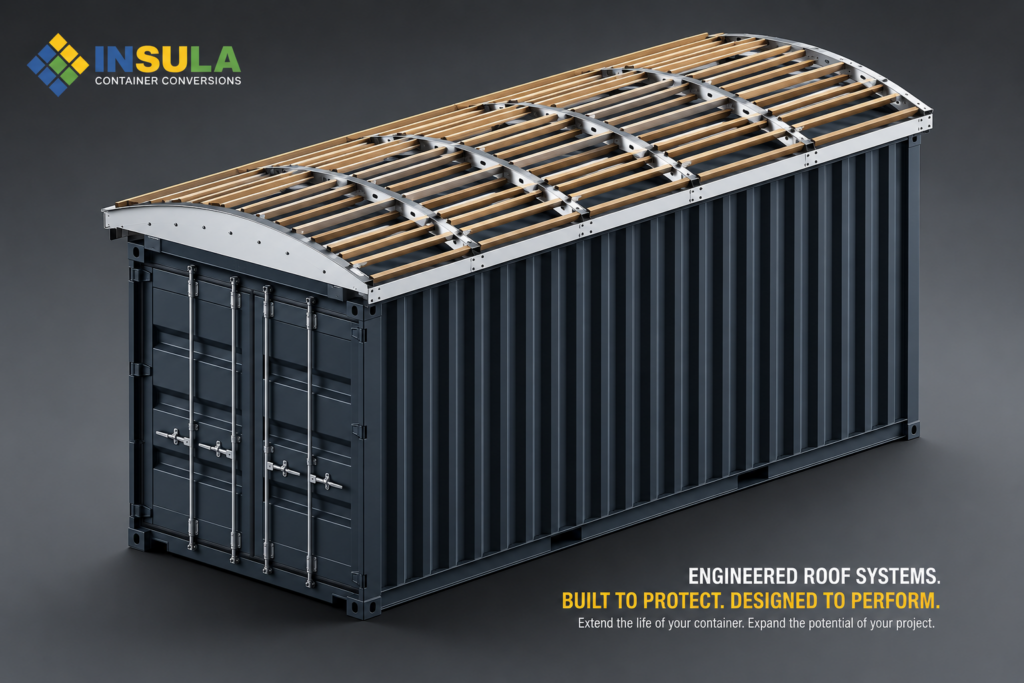
A secondary roof is installed above the original container roof, creating a protective cavity between the two structures. Beyond improving weather protection, this approach offers several practical benefits.
Improved Water Management
A properly engineered roof directs rain and snow away from the container, minimizing standing water and reducing the amount of moisture that reaches the original steel roof. By shielding the container from direct weather exposure, the service life of the structure can be significantly extended.
Better Energy Performance
Steel readily transfers heat, making container roofs susceptible to intense solar heat gain during the summer and rapid heat loss during the winter.
A secondary roof creates space for continuous insulation, ventilation, and thermal breaks, improving year-round comfort while reducing condensation and lowering heating and cooling demands.
Space for Mechanical Infrastructure
The cavity created by the roof system provides an ideal location for building services, including:
Electrical wiring
Plumbing
HVAC ductwork
Communication cabling
Solar infrastructure
Exterior lighting
Insulation
Housing these systems above the ceiling creates cleaner interior spaces while simplifying maintenance and future upgrades.
Greater Design Flexibility
Secondary roofs also allow a container conversion to move beyond its industrial appearance.
Depending on the application, roof systems may be designed as:
Curved roofs
Peaked or gable roofs
Cathedral-style roofs
Mono-slope roofs
The finished roof can then be clad with standing seam steel, traditional roofing materials, architectural panels, membrane roofing systems, or specialty fabric coverings. In commercial applications, the roof structure can also provide opportunities for integrated signage, corporate branding, renewable energy systems, or other project-specific features.
Designing for the Entire Life Cycle
One of the defining characteristics of a well-engineered container conversion is that it considers the entire life cycle of the asset, not just the initial build.
Design decisions should account for long-term durability, moisture management, energy performance, ease of maintenance, and the ability to adapt as operational requirements change.
Features such as secondary roof systems may not be the most visible components of a project, but they often provide some of the greatest long-term value by protecting the original container while improving overall building performance.
At Insula, this philosophy guides every project we undertake. Rather than simply modifying shipping containers, we engineer integrated solutions that improve functionality, extend service life, and allow each container to evolve into a purpose-built structure.
Key Takeaways
When planning a shipping container conversion, thinking beyond the initial build can significantly improve long-term performance and reduce lifecycle costs.
A well-designed secondary roof can:
Protect the original Corten steel roof from rain, snow, UV exposure, and standing water.
Help extend the service life of the container by reducing corrosion and maintenance requirements.
Improve energy efficiency by creating space for insulation, ventilation, and thermal breaks.
Provide a dedicated cavity for electrical, plumbing, HVAC, communications, and renewable energy infrastructure.
Increase architectural flexibility with curved, peaked, cathedral-style, or custom roof designs finished with steel, traditional roofing materials, or membrane systems.
Create opportunities for branding, solar integration, and future expansion while giving the finished conversion the appearance and performance of a conventional building.
Thoughtful engineering is often what separates a basic container modification from a high-performing, long-lasting structure. By considering how a container will perform over the next 20 to 40 years, not simply how it looks on day one, owners can maximize both the value and longevity of their investment.
Have roofing questions, reach out and let’s chat.