
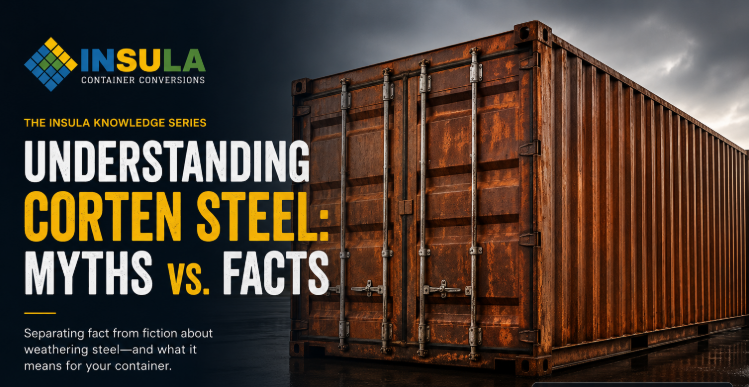
The Insula Knowledge Series
If you’ve researched shipping containers, you’ve probably come across the term Corten steel. It’s often described as “rust-proof,” “maintenance-free,” or even “self-healing.”
While Corten steel is an impressive engineering material, many of these claims are misconceptions.
Understanding what Corten steel is, and what it isn’t, can help you make better decisions when purchasing, modifying, or maintaining a shipping container.
What Is Corten Steel?
Corten steel, also known as weathering steel, is a high-strength structural steel alloy developed to withstand long-term outdoor exposure.
Unlike conventional carbon steel, Corten contains alloying elements such as copper, chromium, nickel, and phosphorus. When exposed to alternating wet and dry conditions, these elements form a tightly bonded oxide layer, commonly called a patina.
This patina slows the corrosion process by protecting the steel beneath it.
It’s important to note that the patina is not a coating or paint. It is part of the steel itself.
Myth #1: Corten Steel Doesn’t Rust
Fact: Corten steel absolutely rusts.
In fact, the protective patina is rust.
The difference is that the rust develops into a dense, stable layer that protects the underlying steel from continued corrosion. Conventional steel often develops loose, flaky rust that continues to deteriorate over time.
Weathering steel simply rusts differently.
Myth #2: Shipping Containers Are Maintenance-Free
Fact: All steel structures require inspection and maintenance.
Although Corten steel significantly reduces corrosion compared to conventional steel, shipping containers still benefit from routine inspections.
Owners should periodically check for:
Damaged paint
Standing water
Roof debris
Deep scratches
Areas where moisture remains trapped
Addressing these issues early or designing solutions with them in mind can add years, or even decades to the life of a container.
Myth #3: Water Doesn’t Affect Corten Steel
Fact: Standing water is one of Corten steel’s biggest challenges.
The protective patina develops best when the steel experiences alternating wet and dry cycles.
If water remains trapped against the surface for extended periods, oxygen cannot reach the steel evenly, preventing the protective layer from stabilizing.
This is why roof drainage is such an important consideration in permanent container installations, especially in climates that include water that freezes, as when the water freezes into ice it has the potential to crack the steel.
Reducing standing water helps preserve the container’s structural integrity over the long term.
Myth #4: Surface Rust Means the Container Is Failing
Fact: Surface rust is often completely normal.
Many first-time buyers become concerned when they see orange or brown discoloration on a shipping container.
In many cases, this is simply the natural weathering process.
What matters is understanding the difference between:
Cosmetic surface oxidation
Localized corrosion
Structural deterioration
An experienced container specialist can distinguish between normal aging and areas that require repair.
Myth #5: Every Shipping Container Is the Same
Fact: Containers vary significantly in condition.
Age, previous cargo, maintenance history, environmental exposure, and structural damage all influence a container’s remaining service life.
For example:
A container that spent years in a dry inland environment may have considerably less corrosion than one exposed to decades of salt spray near coastal shipping routes.
Selecting the right container is just as important as designing the conversion itself.
How Engineering Can Extend the Life of Corten Steel
Good engineering works with the material rather than against it.
Thoughtful container conversions consider:
Water management
Ventilation
Protective roof systems
Proper insulation
Accessible maintenance areas
High-quality coatings where required
These design choices help reduce moisture accumulation while preserving the natural advantages of Corten steel.
Looking Beyond the Container
At Insula, we view the shipping container as the foundation of a long-term engineered asset rather than simply a steel box.
Whether designing modular roof systems, bolt-together structural kits, or complete container conversions, our objective is always the same: maximize durability, improve performance, and extend the useful life of the original structure.
Understanding the materials is the first step toward designing better container solutions.
Key Takeaways
When it comes to Corten steel, understanding the facts can help you make better decisions and protect your investment.
Corten steel is weathering steel—not rust-proof steel.
The protective patina is controlled rust that slows future corrosion.
Standing water is one of the biggest threats to long-term durability.
Routine inspections and maintenance still play an important role.
Not all shipping containers are equal—condition matters.
Thoughtful engineering and moisture management can significantly extend a container’s service life.
The more you understand the materials you’re building with, the better equipped you’ll be to create shipping container conversions that perform reliably for decades.