
Why Insula Conversions Should Be the Standard in Humanitarian and Disaster Relief
Every day, shipping containers deliver critical supplies to places that need them most. Food, medical equipment, emergency shelter and more. They arrive exactly when and where they’re needed, and then, all too often, their job is considered done.
But a shipping container isn’t disposable. It was NEVER designed to be.
These steel structures are built to last decades, to cross oceans and continents again and again. Treating them as single-use delivery tools doesn’t just waste material, it misses a powerful opportunity to do more good with what’s already there.
At Insula, we believe the shipping container has a responsibility beyond delivery. And in humanitarian and disaster relief work especially, that responsibility matters.
Rethinking What Happens After the Doors Open
In many relief scenarios, containers are unloaded and left behind. Sometimes they’re stored indefinitely. Sometimes they’re abandoned. Sometimes they quietly become someone else’s problem.
The reality is, those containers could be doing meaningful work long after the supplies inside them are distributed. With the right planning, they can become clinics, washrooms, kitchens, power stations, storage spaces, or coordination hubs, exactly the kinds of facilities relief teams and communities urgently need.
Once you see that potential, it becomes hard to ignore it.
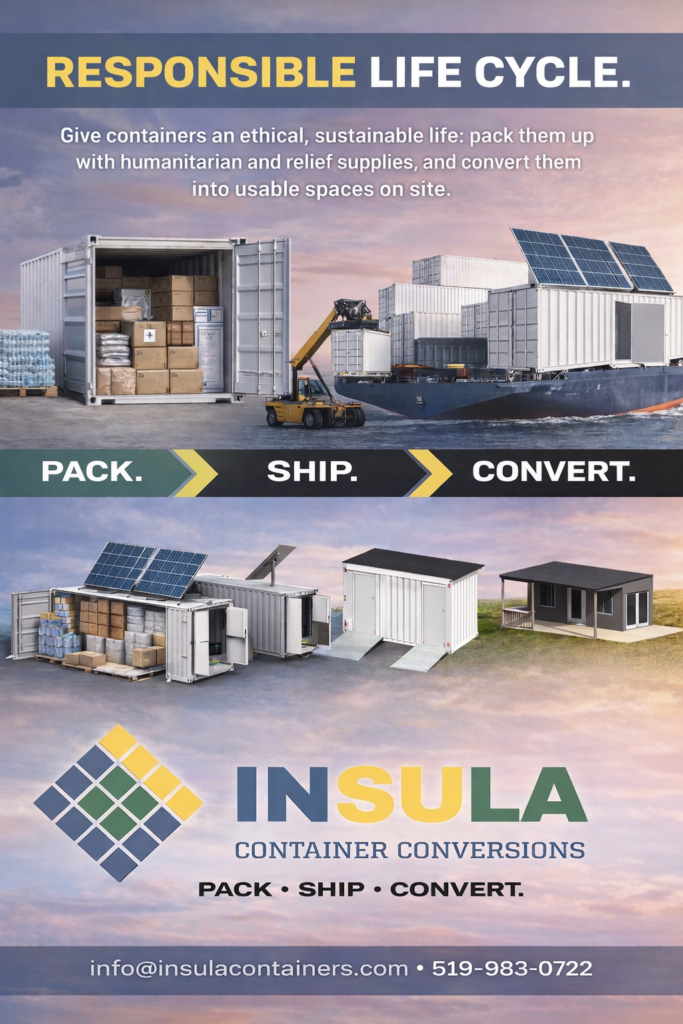
A Simple Shift in Thinking: Pack, Ship, Convert
The idea is straightforward. Containers arrive packed with humanitarian supplies, but they also arrive with a plan. Alongside the cargo are modular, bolt-on, bolt-together kits that allow the container itself to be converted on site.
No heavy construction. No specialized trades. No complex infrastructure.
The systems are intentionally simple, designed to be assembled with basic tools and installed by local people wherever possible. Much like flat-pack furniture, the components are standardized, intuitive, and flexible enough to adapt to different needs as situations evolve.
The container doesn’t stop being useful once it’s unloaded, it simply changes roles.
Why Local Assembly Matters
One of the most important aspects of this approach is who gets to build it. By removing the need for highly skilled trades, container conversion becomes something communities can take part in themselves.
That means faster deployment, lower costs, and fewer logistical bottlenecks. But it also means something more meaningful: local involvement, local ownership, and skills that remain long after outside teams have moved on.
When infrastructure is built by the people who use it, it tends to last.
From Temporary Aid to Lasting Value
What makes this model so powerful is its longevity. A container can serve multiple life cycles. First as a delivery vessel, then as immediate response infrastructure, and later as a long-term asset that continues to support the community.
Solar charging stations, medical spaces, sanitation facilities, secure storage, kitchens, or shelters don’t need to disappear when the emergency phase ends. They can adapt, relocate, or be repurposed as needs change.
This stretches budgets further, reduces waste, and ensures that aid efforts leave something useful behind.
Why Conversion Is No Longer a Choice
Today, organizations loading containers with humanitarian supplies face a different reality than they did even a decade ago. Accountability has increased. Environmental responsibility matters. Donors, partners, and communities are paying attention to what happens after delivery.
With proven, practical ways to convert containers already available, leaving them unused or abandoned is becoming harder to justify.
Especially in disaster relief and humanitarian work, where resources are limited and needs are immense, conversion isn’t an extra step. It’s the responsible one.
A Better Way Forward
At Insula Containers, we see shipping containers not as temporary assets, but as building blocks for resilient, adaptable infrastructure. Every container shipped should arrive with a clear purpose beyond unloading, and a future beyond the crisis itself.
Pack with intention. Ship with accountability. Convert with care.
When we treat containers this way, we don’t just deliver aid, we leave behind something that continues to help long after the doors are opened.